
Structured Interview : Example and Template

Leverage your Interview Data
AI interview notes, scorecard, follow-up, ATS integration, and more...
.svg)
.svg)
How can you ensure that every candidate has a fair chance to shine?
The answer lies in structured interviews.
In this article, we delve into the heart of this method, exploring its benefits, and the ways in which it can be implemented.
What are Structured Job Interviews vs Non-Structured ?
A structured interview is a systematic, standardized approach where you prepare every question in advance and ask all candidates the same questions in the same order. This is true whether questions are open-ended or closed-ended — your interview script doesn’t change once it’s set. That makes your process predictable and easier to score objectively.
Unstructured interviews are everything a structured interview isn’t. There’s no fixed list of questions or script; instead, the conversation flows naturally, just like a dialogue.
While flexible, unstructured interviews make comparisons across candidates harder because each conversation can diverge significantly. Measures of objectivity and consistency are low, which is why this approach is more common in exploratory research than in formal hiring decisions.
Why Structured Interviews Are More Accurate
One of the strongest findings in hiring research is that structured interviews are much more predictive of future job success than unstructured interviews. A meta-analysis of interview methods found that structured interviews are nearly twice as predictive of job performance.
Why is that so?
Imagine you give each candidate different questions and follow-ups. This might allow spontaneity, but definitely lack comparability and fairness for candidates. Structured interviews avoid this by asking every candidate the same set of questions in the same order, which improves consistency and fairness.
According to organizational research, structured interviewing not only enhances predictive validity but also increases agreement among interviewers. When everyone uses the same criteria and scoring guide, turn out interviewers tend to evaluate responses more similarly, which strengthens reliability.
This also supports fairer treatment across demographic groups. Research collected by organizations like Google’s People Analytics team shows structured interviews lead to decreased differences between demographic groups in evaluations and thus biases, meaning your team can make decisions that are both equitable and defensible.
Tips for Conducting a Structured Interview

As its name suggests, structured interviews involve adopting a rigorous, well-defined process that avoids disgressions and improvisation.
Here's how to set it up in 5 steps:
1. Identifying Key Skills
The first step is crucial: gather your recruiting team and managers to pinpoint the key skills required for the position.
Start by listing the technical or "hard" skills necessary for the job. Are you looking for a top-notch strategist or a natural communicator? Perhaps both? Analyze the job description to determine the essential skills, both technical and behavioral. For example, a developer might need strong coding skills and the ability to work collaboratively in a team setting.
Next, consider the "soft" skills. Qualities like creativity, resilience, and teamwork are often just as crucial as technical abilities. After all, you can teach skills, but character traits are usually ingrained.
Once you've identified the necessary skills, prioritize them. Which are critical for day-one performance, and which can be developed over time? This prioritization helps focus your questions on what truly matters for success in the role.
2. Crafting Questions
With your evaluation criteria in hand, it's time to develop your questionnaire—the core of your structured interview. You’ll need to transform your criteria into powerful questions that reveal the true nature of your candidates.
There are two types of questions to prepare:
- Behavioral questions delve into the candidate’s past experiences. For example, if you're looking for someone with excellent conflict resolution skills, you might ask, "Can you describe a time when you had to manage a disagreement within your team? How did you handle it?" Such questions provide a glimpse into how candidates have handled real-world situations.
- Situational questions assess how candidates might handle hypothetical scenarios they could face in the job. For instance, "Imagine you have a project with a tight deadline and limited resources. How would you prioritize your tasks?" This type of question helps you understand a candidate’s reasoning and decision-making process.
By combining these questions, you create a robust framework to assess both past behavior and potential future performance, giving you a comprehensive view of each candidate's capabilities.
3. Developing a Rating Scale
Once your questions are set, establish a rating scale. This is vital for ensuring that the interviews don’t become subjective judgments. Define several possible answers for each question and assign them a score.
Your rubric might assign ratings like:
- 1 = Does not meet expectations
- 3 = Meets expectations
- 5 = Exceeds expectations
Most importantly, include space for evidence and examples so you tie every score back to what the candidate actually said.
4. Conducting the Interview
Now it’s time to bring your preparation to life. Start each interview by setting the right tone—be welcoming and professional. A firm handshake, a warm smile, and a friendly greeting can make all the difference. Ensure the candidate is comfortable; a relaxed candidate is more likely to reveal their true self.
Follow your structured guide and ask each question in order. However, remain attentive to the candidate's responses. Active listening is key. If a response intrigues you or feels incomplete, don’t hesitate to probe deeper.
Remember to take detailed notes, not just on what the candidates say but how they say it. Non-verbal cues can be just as telling as the spoken word.
5. Reviewing and Decision Making
After the interview, take time to review your notes and evaluate each response using your rating scale. Like a judge in a talent show, be precise, fair, and objective. Assess each answer based on how well it matches the established criteria.
Compile your evaluations to compare candidates effectively. This might involve creating a summary table or chart that clearly shows each candidate's strengths and weaknesses based on the predefined criteria.
Finally, before making your decision, consider the candidate's overall profile—their experience, skills, and personality—and how they fit within your company's culture.
By carefully following these steps, you ensure your structured interviews are not only effective but also instrumental in making the best hiring decisions for your company.
Structured Interview Template

Below is a plain-text structured interview template you can copy, paste, and adapt to any role.
A. Interview Context
Start by setting clear context. This ensures anyone reading the report later understands the situation immediately.
- Candidate name:
- Role interviewed for:
- Team / department:
- Interview date:
- Interviewer name:
- Interview format: (phone / video / on-site)
- Interview stage: (screening / round 1 / round 2 / final)
B. Competencies Assessed
List the competencies you are explicitly evaluating in this interview. These should come directly from the role requirements.
Competency 1:
(Example: Technical expertise in X)
Competency 2:
(Example: Problem-solving and decision-making)
Competency 3:
(Example: Communication)
Competency 4:
(Example: Collaboration / teamwork)
Competency 5:
(Example: Motivation and role fit)
C. Interview Questions (Ask in the Same Order for Every Candidate)
Question 1 — Technical / Role-Specific
Question:
“Can you describe a recent project where you used [specific skill]?”
Notes on candidate answer:
Follow-up (if needed):
“What challenges did you face and how did you resolve them?”
Question 2 — Problem-Solving
Question:
“Tell me about a time you faced an unexpected problem at work. What did you do?”
Notes on candidate answer:
Follow-up:
“What was the outcome?”
Question 3 — Communication
Question:
“Describe a situation where you had to explain something complex to others.”
Notes on candidate answer:
Follow-up:
“How did you check that people understood you?”
Question 4 — Collaboration
Question:
“Tell me about a time you worked with others under pressure.”
Notes on candidate answer:
Follow-up:
“How did you handle disagreement?”
Question 5 — Motivation & Fit
Question:
“What motivated you to apply for this role, and what are you looking for next?”
Notes on candidate answer:
D. Scoring (Complete Immediately After the Interview)
Use the same scale for every candidate.
Score scale:
- 1 = Does not meet expectations
- 2 = Below expectations
- 3 = Meets expectations
- 4 = Exceeds expectations
- 5 = Strongly exceeds expectations
Competency 1 score:
Evidence supporting this score:
Competency 2 score:
Evidence supporting this score:
Competency 3 score:
Evidence supporting this score:
Competency 4 score:
Evidence supporting this score:
Competency 5 score:
Evidence supporting this score:
E. Strengths (With Evidence)
List only strengths you can support with examples from the interview.
- Strength 1:
Evidence / example: - Strength 2:
Evidence / example:
F. Risks or Concerns (With Evidence)
This section is critical for fair decisions. Avoid opinions. Stick to facts.
- Concern 1:
What triggered it:
How serious is it: (low / medium / high) - Concern 2:
What triggered it:
How to validate next: (test / follow-up / reference)
G. Overall Recommendation
Force a clear decision to avoid vague feedback.
Recommendation:
- Strong hire
- Hire
- Hire with reservations
- Do not hire
Justification (2–3 sentences based on evidence):
Suggested next step:
- Move to next round
- Additional interview
- Case study / test
- Reference checks
- Close process
Examples of Structured Interview Questions
Having a hard time formulating fair and effective questions in a structured interview ? Below, you'll find ten examples each of behavioral and situational questions :
Behavioral Questions
Behavioral questions aim to reveal how a candidate has handled real-life situations in the past, based on the premise that past behavior is a good predictor of future behavior. Here are ten behavioral questions you can use:
- Adaptability: Describe a time when you had to work closely with someone whose personality was very different from yours.
- Project Management: Tell me about a project that you planned. How did you organize and schedule the tasks?
- Accountability: Can you give me an example of a time you made a mistake? How did you handle it?
- Decision-Making: Discuss an instance when you had to make a decision without all the information you needed.
- Conflict Resolution: Describe a situation where you had to deal with a difficult client or customer.
- Goal Achievement: Give an example of a goal you reached and tell me how you achieved it.
- Independence: Tell me about a time when you worked under close supervision or extremely loose supervision.
- Commitment: Describe a time when you had to go above and beyond the call of duty to get a job done.
- Prioritization: Give me an example of a time you had to prioritize multiple projects.
- Written Communication: Tell me about a time when you had to rely on written communication to get your ideas across to your team.
Situational Questions
Situational questions help you understand how a candidate might handle hypothetical job-related scenarios. These questions are crafted to gauge a candidate’s reasoning, problem-solving abilities, and future performance in specific situations.
- Problem-Solving: Imagine you are working on a tight deadline but waiting on information from a coworker. What steps would you take?
- Leadership: If you noticed that your team's morale was low, what actions would you take to boost it?
- Integrity: Suppose you find a significant error in a project that has already been distributed to the client. What would you do?
- Time Management: Imagine that you have conflicting deadlines. How would you decide which assignment to prioritize?
- Learning Agility: If given a new project in an area you are unfamiliar with, how would you proceed?
- Conflict Resolution: How would you handle a situation where you disagreed with your manager’s instructions?
- Team Management: Suppose you have a team member who is not pulling their weight. What would you do?
- Change Management: Imagine you are tasked with implementing a change that you do not agree with. How would you handle it?
- Interpersonal Skills: What steps would you take if you were assigned to work with a team member you found difficult to work with?
- Innovation: If you discovered a process that could be significantly improved, but it would disrupt current procedures, how would you handle it?
Structure Interviews with AI : Noota
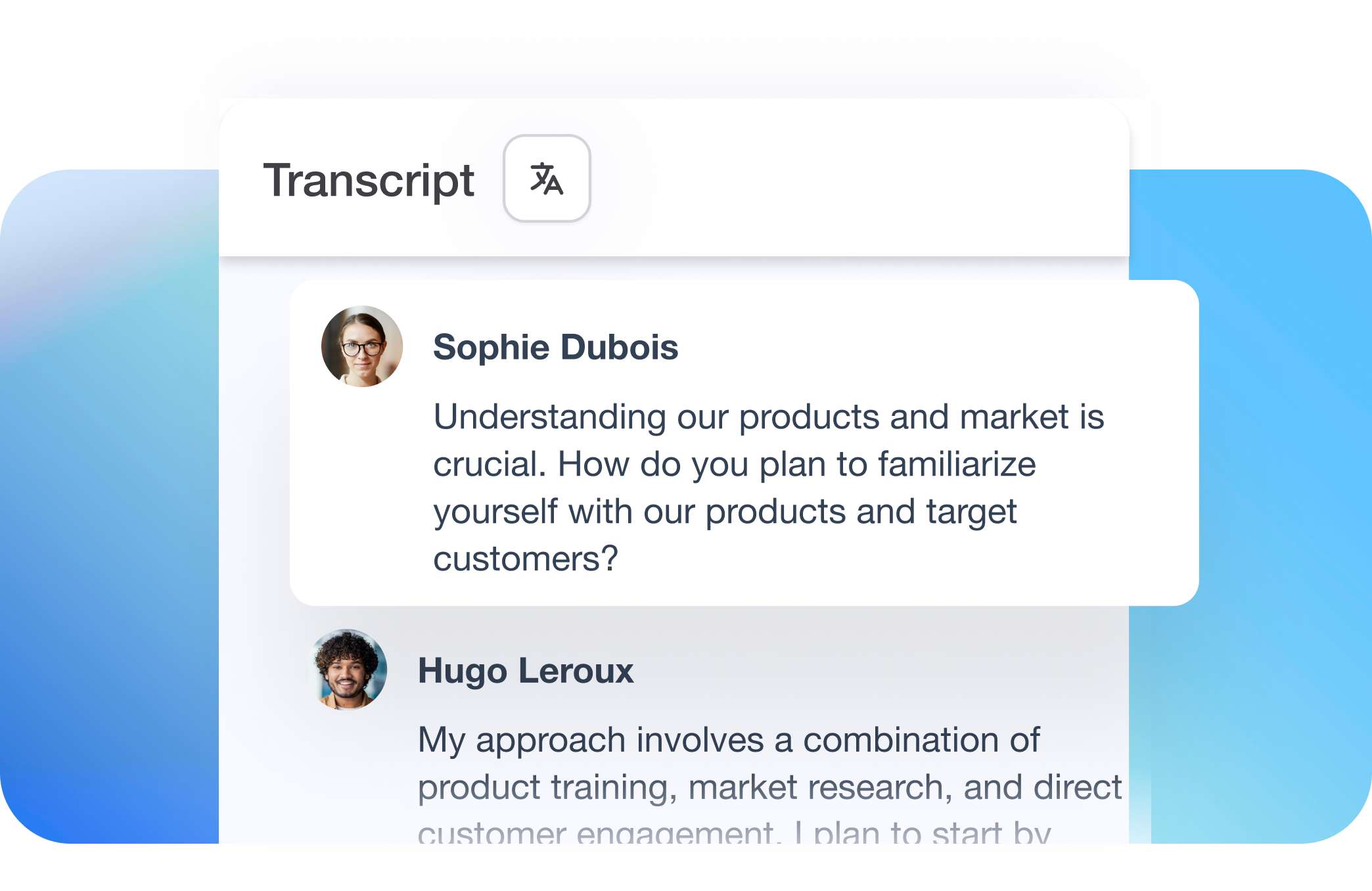
Looking to streamline your structured interviews? Noota not only remind of your questions during the interview but also track your candidate's every response :
- Reminder Feature: Ever forget to ask a crucial question during an interview? With Noota, that’s a thing of the past. It acts like an integrated cheat sheet, ensuring you cover all essential aspects of the interview. This ensures consistency and comprehensiveness in every interview you conduct.
- Response Tracking: Noota meticulously records and analyzes each response. You don’t have to worry about missing important details or mixing up responses from different candidates. Everything is neatly organized and easily accessible, allowing for thorough and accurate evaluations.
- Structured & Objective Built-in Scorecard: After the interview, Noota provides a detailed report and customizable scoring sheet highlighting the candidate’s strengths and areas for improvement. This feature helps you make more informed decisions by clearly outlining how each candidate matches up against the job requirements.
Want to automatically structure your interviews ? Try Noota for free now.
FAQ
❓ Q: Do I have to use structured interviews for every role?
Not necessarily — but you should use them when your goal is fair comparison and accurate prediction of job performance. Structured interviews are best for roles where you need consistency across candidates and clear evidence tied to job criteria.
For less formal screenings or exploratory conversations (like early culture-fit discussions), a semi-structured approach can work. It lets you combine core questions with natural dialogue.
❓ Q: How do I manage follow-up questions without breaking structure?
The strength of structured interviews is asking the same core questions in the same order for every candidate.
That said, you can build planned follow-ups into your structure — for example, predefined probing questions tied to specific responses. As long as you apply them consistently and score them using your rubric, you’re not breaking structure; you’re enhancing clarity.
❓ Q: Can candidates ask their own questions during a structured interview?
Yes — candidate questions are valuable for engagement and rapport. But timing matters. Many structured interview frameworks recommend saving open-ended candidate questions for after the core structured portion. This keeps your evaluation comparable while still giving the candidate room to learn about your company.
Think of your structured part as the assessment phase and the candidate’s questions as the engagement phase. They both matter — just at different points in the conversation.
❓ Q: How long should a structured interview take?
There’s no fixed rule, but your structured portion should be long enough to cover all competencies and scoring criteria consistently. In practice, this often means 45-60 minutes for mid-senior roles and 30-45 minutes for more tactical positions.
If your structured questions take less than that, you may not be gathering enough data to differentiate candidates fairly. Likewise, if it’s much longer, you may be duplicating evaluation areas.
❓ Q: How do structured interviews improve the candidate experience?
Candidates notice consistency and fairness. When interviews are predictable and every applicant receives the same evaluation process, candidates feel respected and treated equally — which boosts their perception of your employer brand.
Structured interviews also reduce off-topic or irrelevant questions, which can frustrate candidates and leave them unsure about what really matters in the role.
❓ Q: Should I train my interviewers specifically for structured interviews?
Absolutely — training is critical. Structured interviews only work well if interviewers know how to:
- Ask questions consistently
- Use your scoring rubric correctly
- Avoid injecting personal bias into ratings
A training session ensures everyone interprets and scores answers the same way, which is essential for fairness and reliability.
❓ Q: What if my scorecards or rubrics are too rigid?
Your rubrics need clarity and room for nuance. If your scoring scale is too narrow (e.g., just Yes/No), you may miss subtle differences in candidate quality. Conversely, overly broad scales can lead to inconsistent interpretations.
Instead, choose a rating system (1–5 or similar) with defined benchmarks for each level. That way, interviewers score based on evidence rather than impression.
❓ Q: Are structured interviews legally safer?
Because structured interviews use predetermined questions and scoring criteria, they provide a clear audit trail of how decisions were made. That documentation helps defend your hiring practices and can reduce legal risks associated with bias or discrimination claims.
Leverage your Interview Data
AI interview notes, scorecard, follow-up, ATS integration, and more...

Jean-marc is an AI expert helping recruiters & professionnals leverage these tools in their everyday work.
Related articles
.webp)

.png)


Forget note-taking and
try Noota now
FAQ
In the first case, you can directly activate recording as soon as you join a videoconference.
In the second case, you can add a bot to your videoconference, which will record everything.
Noota also enables you to translate your files into over 30 languages.
.svg)